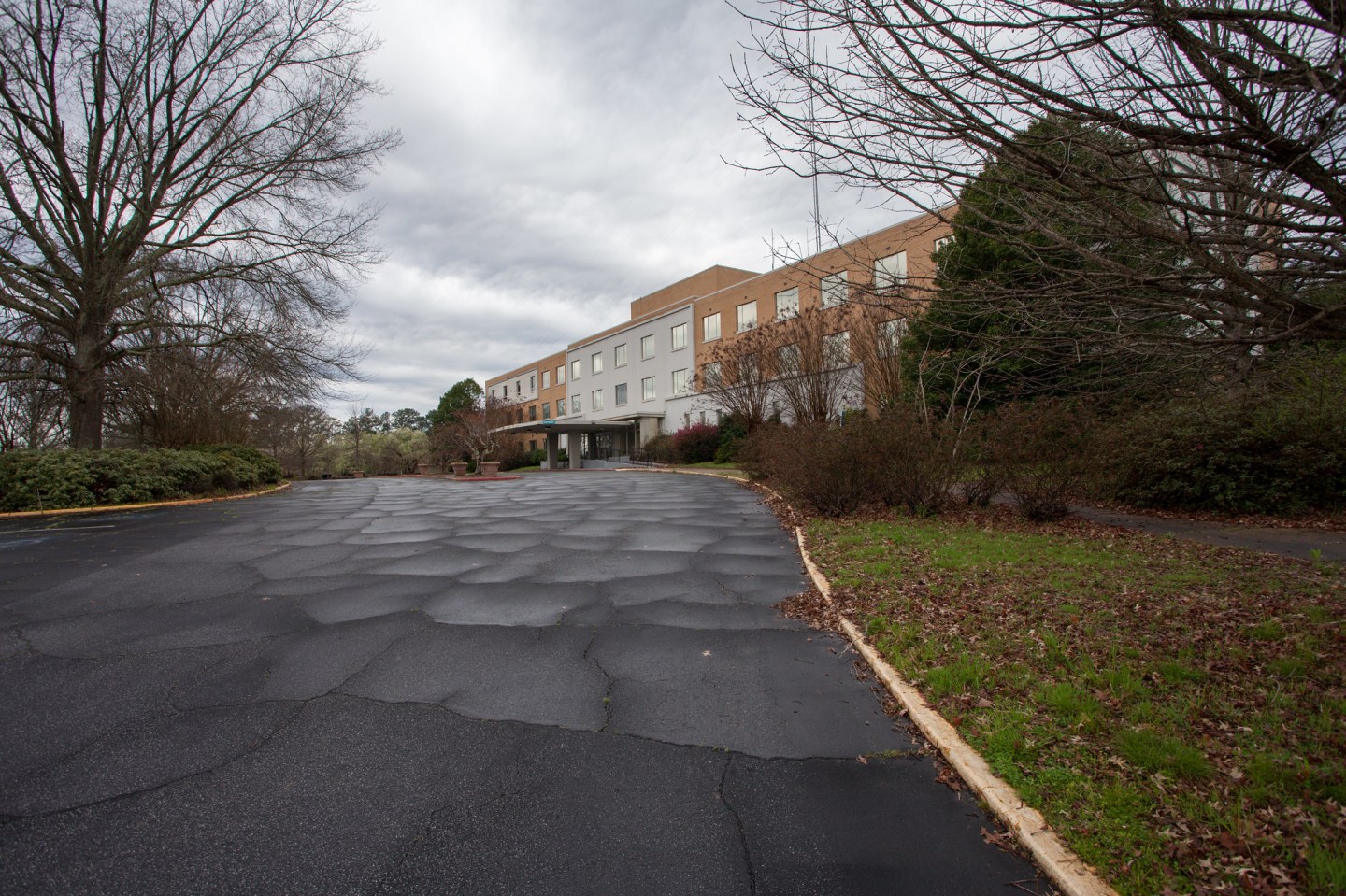
The Coweta County Hospital Authority was formed in 1957 under the State Legislative Act known as the Hospital Authorities Law. It stipulated that Hospital Authorities can be established to carry out the purposes and provisions of the law, namely, to provide healthcare needs for the community. A part of the Hospital Authority’s charge was to plan for the unmet healthcare needs of the community. These officials saw a need for more medical services in Coweta County. Plans for the new hospital were drawn, land was acquired, and construction began by September 1960.

On October 1, 1962, Coweta General Hospital opened its doors to its first patients. The hospital was established by the Coweta County Hospital Authority to serve lower income residents who could not afford Newnan’s private city hospital. Construction began in August 1960 by S. J. Curry and Company of Albany. Under the Hill-Burton plan, state and federal aid were provided for the hospital, and the entire cost of the hospital was $2.4 million, with $1 million in federal aid approved by the Dept. Of Health, Education, and Welfare. Constructed in an H-shape and built of brick and marble, the four-story 125-bed building was equipped with 2 operating rooms, a state-of-the-art radiology department, a chapel, and a 76-seat cafeteria open to hospital personnel and the public. It was the first hospital in the county to serve both white and black patients.

Throughout its construction and opening, Coweta General was highlighted in the local newspaper, one article highlighted its complex mechanical system that included 300 tons of air conditioning. Two boilers in the basement generate enough steam to heat 250 average homes. More than 15,000 feet of steel and copper tubes distribute heating and cooling to each room in the hospital, and electric filters provide the operating rooms with super clean outside air at the right temperature and humidity. An impressive 100,000 cubic feet of air are circulated every minute by eight large fans in the basement and penthouse equipment rooms. Coweta General Hospital experienced numerous expansions including the addition of a $240,000 Pediatrics Department wing immediately after construction began on the main building.
In its first decade of operation bed capacity increased from 128 beds to 144 beds. A significant expansion in June 1975 added to the emergency department and expanded the laboratories. Coweta General briefly served as the county morgue during this time. In its first 20 years, Coweta General underwent many changes. Several areas were expanded and modernized including the first-floor patient area, pathology and clinical laboratory, radiology, emergency room, intensive care units, physical therapy, respiratory therapy, pediatrics, the nursery, and the medical/surgical wing.

Newnan Hospital, the city’s private hospital, did not accept patients under most federally funded medical payment programs when it opened. In the late 1970s, Newnan Hospital began accepting these funds. As a result of the change, Coweta General Hospital saw a drastic drop in patient numbers, staff and services were cut, and a wing was closed. The hospital authority began investigating the pros and cons of selling the hospital. As the debt continued to rise, the hospital authority decided to sell Coweta General Hospital to Humana, Inc., a billion-dollar hospital chain in 1982 for about $12 million. The name of the hospital was changed to Humana Hospital-Newnan.
In 1991, Humana Hospital-Newnan was recognized as being in the top 1% of the nation’s hospitals. The hospital received its accreditation with commendation from the Joint Commission on the Accreditation of Healthcare Organizations, placing a 98 out of a possible score of 100. Of the country’s nearly 7,000 hospitals, 5,400 participate in the Joint Commission’s accreditation program. Keynote speaker for the accreditation recognition program was then-Sixth District Congressman Newt Gingrich.
By the 1990s, Humana, Inc. was the largest hospital chain in the country. In 1993, to streamline operations, the company was divided into two publicly held firms. One firm called Galen Health Care, Inc. managed hospitals, while the other managed health care plans, offered insurance and retained the Humana name. With the planting of a ceremonial peach tree on the front lawn, Humana Hospital-Newnan officially became Peachtree Regional Hospital in March 1993.
The name change was made as part of the transition. A re-dedication ceremony, health fair, and “Humana memorabilia sale” were held at the hospital to celebrate the name change. In 1999, Peachtree Regional officials approved changing the hospital’s name to Emory Peachtree Regional Hospital. The shift reflected a deal made i in November 1998 linking the hospital to Emory Healthcare. The affiliation with Emory allowed the hospital to expand its services offered to the community.
Newnan Hospital announced in October 2002 its intent to purchase Emory Peachtree Regional Hospital after about three months of private negotiations between Newnan Mayor Keith Brady, Robert Hancock, a member of Newnan Hospital’s board of directors, and HCA officials. The Newnan Hospital Authority authorized a resolution in November 2002 to allow the city to loan Newnan Hospital up to $48.1 million for the purchase of Emory Peachtree Regional Hospital and its assets including property on Bullsboro Drive that was planned for a new hospital.
As locals tapped champagne glasses on December 31, 2002, to ring in 2003, a team of auditors keyed calculators at Newnan’s two hospitals to count inventory. Newnan Hospital obtained possession of its 40-year-old competitor, Emory Peachtree Regional Hospital at midnight. The hospital was renamed Newnan Hospital West Campus and the older Newnan Hospital on Jackson Street was renamed Newnan Hospital East Campus.
In 2006, Newnan Hospital’s medical staff voted to support the proposed acquisition of Newnan Hospital by Atlanta-based Piedmont Healthcare. The doctors said their support of the proposed deal was based on several crucial items in the final agreement that included Piedmont’s commitment to build a modern hospital within 5 years in a “new and central location.” The agreement also called for Piedmont to “infuse millions of dollars” into the former Coweta General facility and to assume Newnan Hospital’s remaining bond debt of roughly $40 million. As promised, a new Piedmont Newnan Hospital opened in May 2012. The hospital moved to its new facility on Poplar Road and vacated the aging facility on Hospital Road.


Since its closure, Coweta General Hospital has become a popular filming location for movies and television shows. The vacant hospital was used as a stand-in for Atlanta’s Grady Memorial Hospital on AMC’s hit show “The Walking Dead” for several episodes in 2014 and 2022. AMC spent $100,000 to give the hospital an abandoned appearance for filming. The Marvel series “The Gifted” filmed its second season at the closed hospital in 2018. The television series, related to the popular X-Men film series, debuted on the Fox television network in October 2017. In January 2021, the STARZ series “Black Mafia Family” produced by 50 Cent filmed scenes at the hospital. The former Coweta General Hospital is currently for sale for $3.9 million.


Thank you for reading this blog! Please share it with your friends. I appreciate your continued support. You can connect with me on Facebook, Instagram, and TikTok. Explore my collection of photography books to discover more incredible, abandoned sites throughout the Southeast.
More recent updates:
Discover more from Abandoned Southeast
Subscribe to get the latest posts sent to your email.

Since this hospital has a long-standing history with the community and has appeared in a few movies and television series, has there been any interested buyers as of yet? It appears in good condition and has a good, structured foundation, it’s definitely worth saving even if it’s turned into something else and not another hospital.
LikeLike