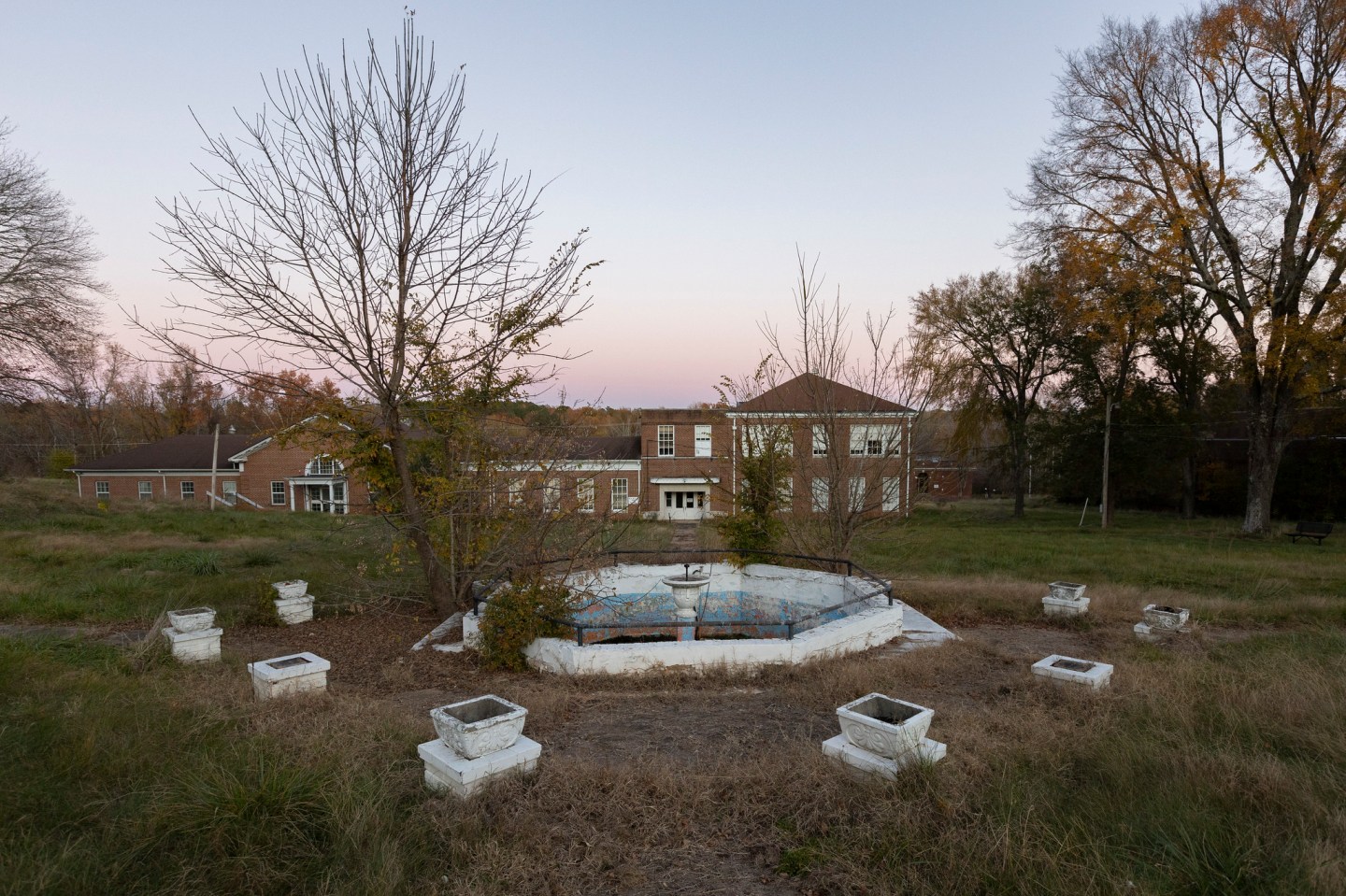
Saint Paul Normal and Industrial School was founded in Lawrenceville, Virginia on September 24, 1888, by James Solomon Russell of the Protestant Episcopal Church. Born into slavery just before the Civil War, Russell became a traveling preacher who founded African American churches across Southside Virginia, including the chapel on the school’s campus. The chapel was an integral part of campus life since students were required to attend services several times a week.
The school was intended chiefly to develop African American teachers, a critical and prestigious job in the late 19th and early 20th-century South and operated as an elementary and high school in its early years. In 1914, the school boasted that “The location of the school in the heart of the Black Belt of Virginia, with a Black population of 100,000 almost at its very doors, is most favorable for the prosecution of uplift work.” James Solomon Russell died at the President’s house in Lawrenceville on March 28, 1935, after an extended illness. He was buried in Saint Paul’s cemetery. His son Rev. J. Alvin Russell continued to run St. Paul College with his wife Nellie Pratt Russell (an incorporator of the Alpha Kappa Alpha sorority), and a board of trustees. His eldest daughter Araminta served as its registrar (800 students were enrolled in the year of his death) until her death in 1937.
The school’s name was changed in 1941 to Saint Paul’s Polytechnic Institute when the state General Assembly granted authority to offer a four-year degree program. The first bachelor’s degree was awarded in 1944. In 1957 the college adopted its present name to reflect its liberal arts and teacher education curricula. Saint Paul’s College focused on the liberal arts, social sciences, education, business, mathematics, and natural sciences.

By the late 20th century, Saint Paul’s College offered undergraduate degrees for traditional college students as well as distant learning students. Working adults could also earn undergraduate degrees through the college’s adult education program. Saint Paul’s College had a Single Parent Support System Program that assisted single teen parents in pursuing a college education.
Saint Paul’s competed in 14 intercollegiate varsity sports: Men’s sports included baseball, basketball, cross country, football, golf, tennis and track & field; while women’s sports included basketball, bowling, cross country, softball, tennis, track & field and volleyball. The college discontinued its athletic programs in July 2011 in an effort to alleviate financial difficulties. The football team had costs of $300,000 to $400,000 annually.
Saint Paul’s had long struggled financially, culminating in a court conflict in June 2012 with its regional accreditor, the Southern Association of Colleges and Schools Commission on Colleges, stripping it of accreditation. Although supporters worked on plans to have St. Augustine’s University in Raleigh, North Carolina, another historically black university of Episcopal heritage, acquire St. Paul’s, the deal was abandoned in May 2013. Shortly thereafter, St. Paul’s College reported to SACS that it would close on June 30, 2013. Although the college had been on probation, it lost its accreditation for “violations concerning financial resources, institutional effectiveness in support services, institutional effectiveness in academics and student services, lack of terminal degrees for too many faculty members, and a lack of financial stability.” The college sued the accreditor, and two months later a court issued a preliminary injunction reinstating the college’s probationary accreditation to protect it during further legal proceedings.
In November 2017, the Pension Benefit Guaranty Corporation, which had assumed ownership of most of the former campus, sold the property to a Chinese-based firm, Xinhua Education Investment Corporation, for $2.5 million. Neither the Town of Lawrenceville nor Brunswick County were officially notified of the sale until the deed was recorded. Repeated efforts by the town to obtain more information about the company that purchased the property, and its proposed use have been unsuccessful. Saint Paul’s College is listed on the National Register of Historic Places and includes more than 130 acres and 30 buildings.
In September 2024, an operation began to remove the leftover contents from the defunct school’s science building. The Virginia Department of Emergency Management (VDEM), Department of Environmental Quality (DEQ), Environmental Protection Agency (EPA), area fire departments, and law enforcement are working together with the owner to secure the building and identify its contents for a safe removal.


Thank you for reading. Please share the blog with your friends. I appreciate your support. You can find me on Facebook, Instagram, and TikTok. For more amazing, abandoned places check out my photography books.
Discover more from Abandoned Southeast
Subscribe to get the latest posts sent to your email.

The many many library books and the extensive lab—all intact and no vandalism for over 10 years. Was this a religious sponsored institution? This is a very sad situation indeed. Just think how much knowledge this institution gave its many decades of students.
Leland, you need to give us a little more information on the background on this institution. Do not need to know location, as it may be safely waiting for some good future news. This institution was much loved I can tell by its condition and apparently well thought out space planning. When did the institution start and how many students? What were the financial mismanagements?
Thanks for another excellent boots on the ground review and many pictures for your readers to get a good flavor of the place.
LikeLiked by 1 person
Unfortunately, I can’t really get into the history at this time without giving away the location. I will update the blog as soon as anything changes.
LikeLike
The article has been updated with the name and history now that a clean out is underway.
LikeLike
Wow, so many things that could have been sold, so many drugs that should have been destroyed, but worse than that, this would have been a perfect place to turn into low income housing or something.
LikeLike