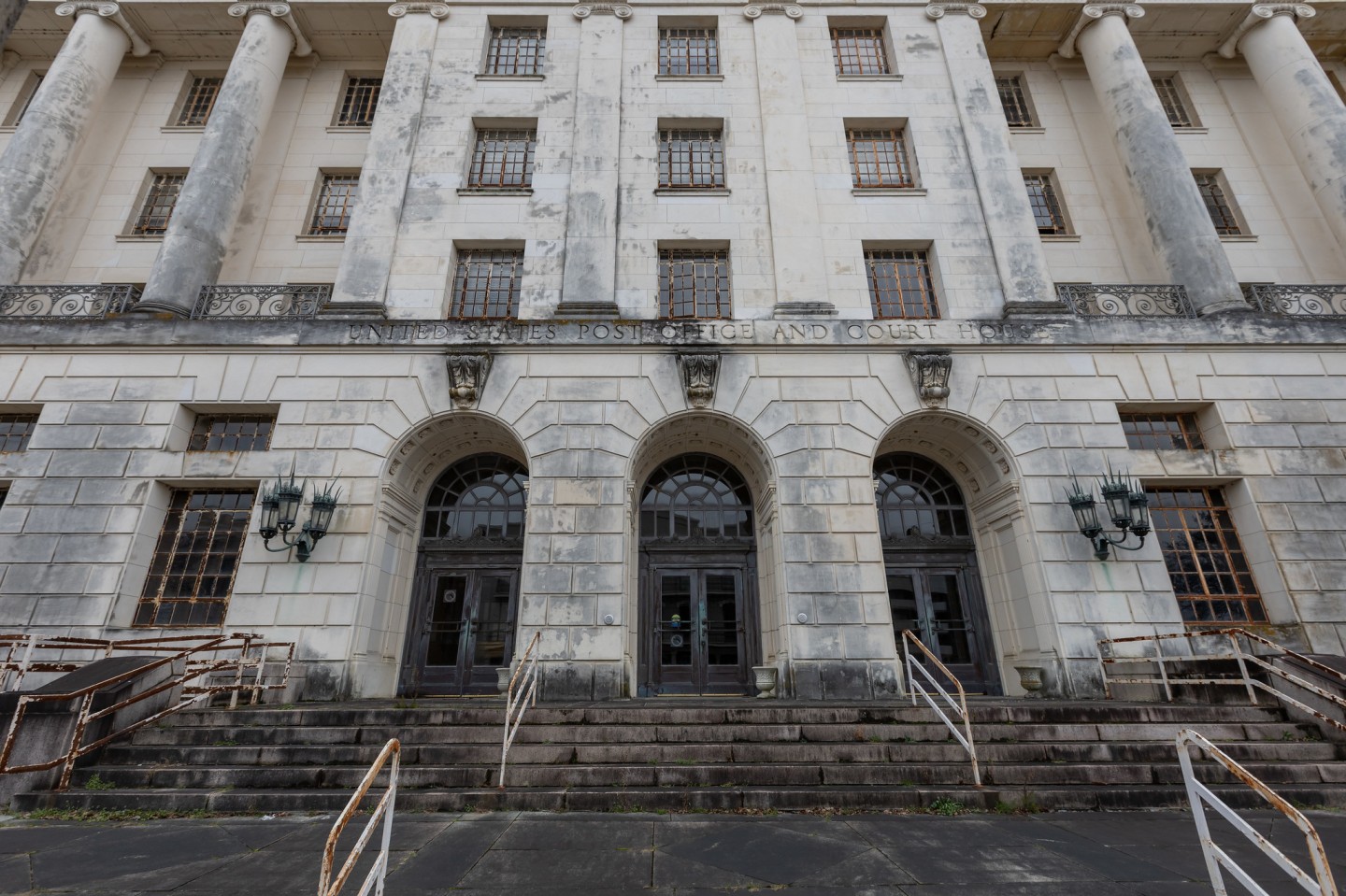
By the 1920s, there was an immediate need for new federal buildings across the Southeast. Federal offices were outdated, overcrowded, and scattered in various locations throughout each state. The United States Congress authorized funding for a new federal building to house various government agencies as well as a centralized courthouse. Built nearly a century ago, this former government building in downtown Vicksburg, Mississippi is an imposing limestone structure.

Construction on the five-story Classical Revival-style post office and courthouse began in 1935 and took two years to finish. Upon completion, the million dollar building, dedicated in June 1937, was the largest and most beautiful of its kind in the state. It was designed by architect Claude H. Lindsley under the administration of Louis A. Simon, Supervising Architect of the Treasury from 1933 to 1939. Lindsley, a Jackson-native barely in his 30s with no formal architectural training, designed a number of buildings that would later become Mississippi landmarks including the Threefoot Building in Meridian and the Standard Life Building in Jackson, two of the state’s most prominent skyscrapers.

C. H. Lindsley designed a number of schools, churches, and courthouses. He left Mississippi and moved to Houston during the Great Depression. While in Houston, he formed the firm of Hedrick & Lindsley with architect Wyatt C. Hedrick, who designed the iconic Sterick Building in Memphis. Lindsley returned to his own independent practice in 1947, continuing in Houston, but he maintained connections on the Mississippi Gulf Coast, with several projects through the 1950s. By 1958, he was listed in the Ocean Springs City Directory on Holcombe Blvd., but apparently he built a house on Ridge Road in Gulf Hills and retired there soon thereafter. He was still using his Houston, TX address on his stamp as late as 1962. Lindsley was married and had two daughters. Claude H. Lindsley died in Ocean Springs in 1969, but is buried in Lakewood Cemetery in Jackson.

The first floor facade is scored to look like stone and has three sets of double bronze doors with fanlights and elaborate bronze entablatures and eight casement windows with transoms. The three entrances are recessed behind large arches. The second, third and fourth floors are separated from the fifth floor by a heavy cornice and from the first floor by a heavy belt course on which is inscribed “United States Post Office and Court House”. The facade of these floors is broken by two recesses dominated by three-story Ionic columns and pilasters. The original lobby remains intact with marble and brass detailing.
The courthouse not only housed the U.S. Federal Court, but also the U.S. District Engineer and several hundred employees engaged in Flood Control Work on the Mississippi River. In 1935, Henriette Amiard Oberteuffer was commissioned by the Works Progress Administration to paint a mural, titled “Vicksburg, Its Character and Industries.” The 12-foot-by-14-foot oil on canvas painting dominates the rear wall of the federal courtroom. The broad canvas depicts loggers, educators, steamers on the Mississippi River loaded with bales of cotton and stately Southern homes sprawled beneath the city’s famed courthouse — as well as Oberteuffer’s father, Karl, in a tank top and with a shovel in hand. Oberteuffer’s work is in the collections of the Art Institute of Chicago, the Phillips Collection, and the Minneapolis Institute of Art.
Works of art commissioned in the federal jobs programs, including large murals, were common in early 20th century courthouses. Some in the South became controversial in the 1970s and 1980s because they depicted whites as aristocrats and laborers, but blacks only in servant roles, such as picking cotton. Draperies were purchased to hide many. Although the Vicksburg mural is an “Old South” tableau, none of its scenes have provoked complaints about stereotyping. Its future will be as the centerpiece of a ballroom in a planned luxury hotel, according to the building’s owner. When a federal building is sold containing a WPA artwork, the new owner must agree to maintain the art and make it available for public viewing.
In 2001, Vicksburg Mayor Laurence Leyens announced that the U.S. Post Office and Courthouse would be donated to the city within two years. The government offered the building to the City of Vicksburg after plans were in the works to move the federal court to Natchez by January 2004. At the time, it was the only building on the block not owned by the city. The mayor had no set plans for the building but hoped to consolidate the city offices that were spread around town to one building and sell off the surplus property. He said the post office would remain on the first floor and pay rent to the city.
However, the plans fell through, and the city never took possession of the property. The Environmental Protection Agency reported that the building contained asbestos that had not been removed. Possibly, this or other potential maintenance issues convinced the city not to accept the property. The federal government sold the building to a private owner around 2007. The current owner plans to transform the building into a boutique hotel. Please do not trespass.


Thank you for reading this blog! Please share it with your friends. I appreciate your continued support. You can connect with me on Facebook, Instagram, and TikTok. Explore my collection of photography books to discover more incredible, abandoned sites throughout the Southeast.
Discover more from Abandoned Southeast
Subscribe to get the latest posts sent to your email.

Leland, thank you for sharing. I’ve been following you for a few months now…. do you keep track of these buildings and if so, do you ever report on someone saving them and turning them into something truly remarkable.
LikeLiked by 1 person
Yes, I do try to keep track of the demolitions and renovations and update the blogs when necessary. I’ve had the opportunity to go back and photograph some renovations like the Marine Hospital in Memphis and the Rockwell Mansion in Milledgeville.
LikeLike