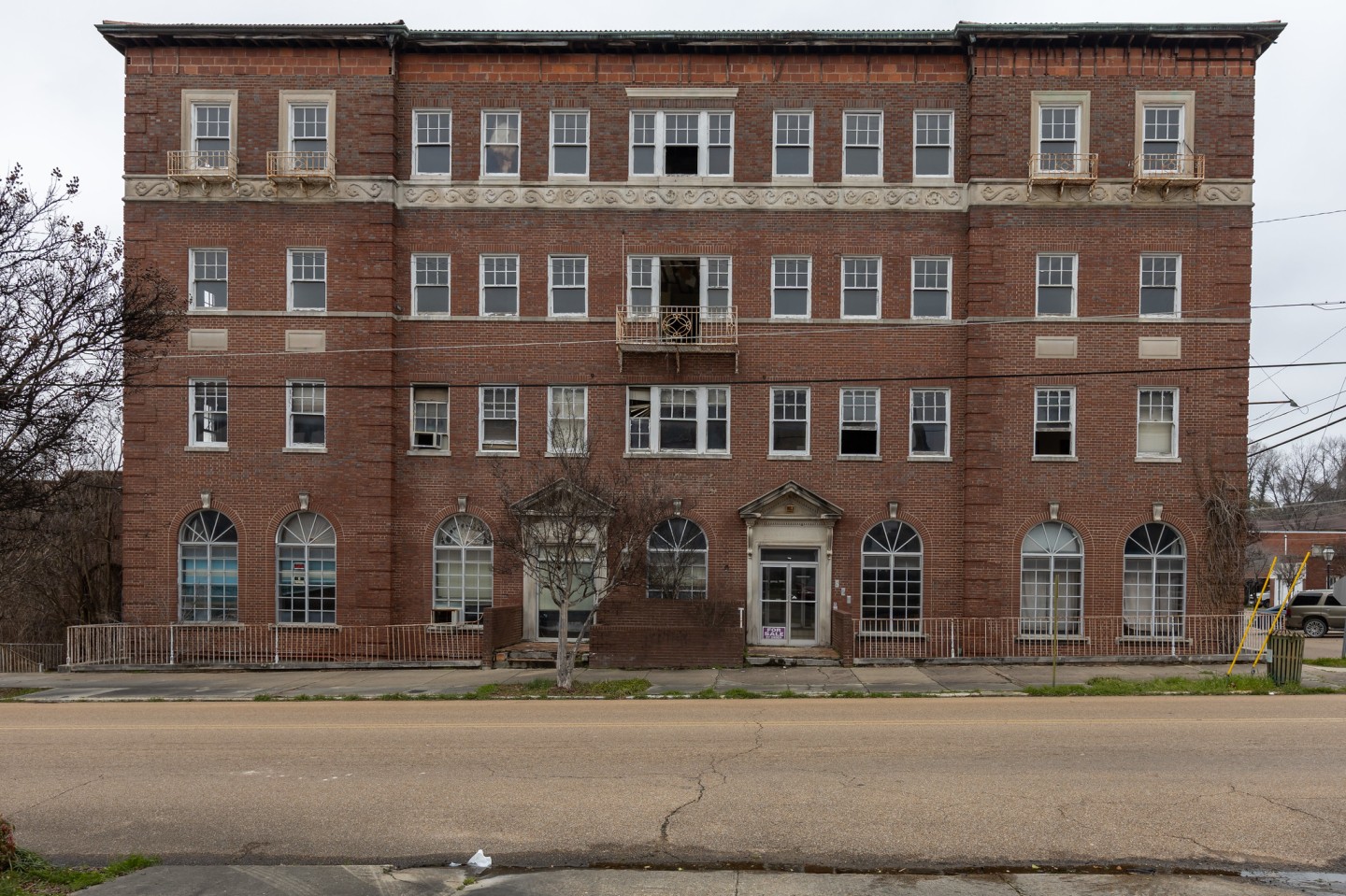
The first Young Men’s Christian Association (YMCA) was founded in 1844 by 22-year-old George Williams with 11 friends in London, England, to address pressing social challenges faced by young men like himself. Years later, retired sea captain Thomas Valentine Sullivan worked as a marine missionary and realized that sailors and merchants also needed a place to call home. In 1851, Sullivan founded the first YMCA in the United States in Boston, inspired by YMCA stories in England. In the 1860s, YMCA housing was established to provide safe and affordable lodging for young men moving from rural areas. These facilities included gyms, auditoriums, and hotel-like rooms.
Early in the 1900s, the YMCA had constructed numerous facilities throughout the Southeast, often serving as a vital resource for men, especially during segregation. A number of these YMCA buildings provided essential services such as safe accommodation, meals, and recreational activities. In May 1919, the Vicksburg Evening Post reported that Mrs. Fannie Johnson, a local philanthropist, planned to donate a lot and fund the construction of a YMCA building in downtown Vicksburg, Mississippi.
Frances “Fannie” Vick Willis Johnson is the great-grandchild of Major Burwell Vick. His brother is Newit Hartwell Vick, who bought the land where Vicksburg is located, and left a portion of his estate to be divided into plots of land for the founding of a city when he died in 1819 of yellow fever. Vicksburg was incorporated in 1825 and named Vicksburg in Newit Vick’s honor by his brother, Burwell (Fannie’s great-grandfather) and son, Hartwell Vick. Fannie married Junius Ward Johnson on May 3, 1881. Following the death of Fannie’s mother in 1900, the couple returned to Mississippi. They lived in Yazoo City for a time and had residences at Panther Burn Plantation and in Vicksburg. Junius Ward Johnson was killed on March 17, 1919, in a tornado when their house at Panther Burn collapsed and crushed him. After his death, Fannie sold Panther Burn Plantation for $1 million.
In July 1919, a meeting was held to announce that the state YMCA had granted a charter to Vicksburg. It was also announced that Mrs. Johnson planned to build a “well-equipped Y for Negro boys and men.” A second YMCA was built at Walnut and Jackson Streets and operated for blacks during segregation. Shortly after it was finally given to the city in the early 1990s, the building collapsed. Vicksburg built and operates the Jackson Street Community Center on that site today.
Fannie Johnson appointed a building committee composed of Paul Polk, C.L. Warner, T.W. McCoy, George Sudduth, Wilson Carroll and J.W. Garrett. Following meetings with several architects, she selected Chicago-based architects Shattuck and Layer to design the building in a Classical Revival style with Beaux Arts elements. In the years prior, Shattuck and Hussey (Shattuck’s partner before Layer) won a design competition for the Chicago YMCA, and went on to design dozens of the nearly 200 YMCA buildings in the United States built between 1906 and World War I. The YMCA treated the firm’s designers as quasi-employees and relied on the firm to produce functional, cost-effective facilities. These could easily be replicated from project to project and reduced risk for local YMCA building committees. Their designs for the Y organization were heavily influenced by the Chicago School which clad steel and concrete structures with masonry and neoclassical details.
Construction of the YMCA in Vicksburg began two years after the project was announced. In March 1922, the Vicksburg Herald reported that “Vicksburg will have a very active Young Men’s Christian Association in a very short time.” The association has been organized, so far as the officers and directors are concerned, but the work of effecting an active organization by securing members has been delayed on account of the lack of a building. Money for the erection of the building has been contributed by Mrs. Fannie Johnson, who has also contributed a very valuable lot, admirably situated for the purpose, but the cost of construction has been regarded as prohibitive.” Underwood Contracting Corporation of New Orleans was chosen to build the new YMCA on the northwest corner of Clay and Monroe streets.
Construction costs were $184,286 for a total of $225,242 including furnishings, and the land cost was $36,000. Fannie Johnson’s gift was $190,000, which she said was not given in memory of her late husband, but regardless, the building would be named after him. An article in the Post reported that “It had been thought that the erection of the Y.M.C.A. building by Mrs. Johnson might be considered, in a sense, as a memorial to her husband, the late J.W. Johnson, who was, for many years, one of the state’s most prominent and influential citizens and one of whom Vicksburg left justly proud.” Mrs. Johnson states, however, that this is not the case. It is true that she and Mr. Johnson talked about the matter of erecting the building many times, and he was just as deeply interested in it as she, but it will not be erected in his memory.”
Contractors constructed 200 to 225 casings, each 200 feet long, to form the foundation for the three-story building. Casings were driven into the ground to support concrete pillars for the building’s foundation. The Junius Ward Johnson YMCA was dedicated November 11, 1923. When it first opened, dues for boys were $6 annually and $10 for men annually; rooms could be rented for $12.50 a month. There are separate entrances, showers, dressing rooms and social rooms for men and boys. There was a billiard room, an indoor pool, a well-equipped gymnasium with a gallery above the gym and a stage at the north end, and 33 dormitory rooms. When it became clear that additional residence rooms were needed, a fourth floor was added in 1929 at a cost of $47,912.


The Junius Ward Johnson YMCA was added to the National Register of Historic Places as a contributing element to the Uptown Vicksburg Historic District in 1993 and was more recently included as a previously listed element in the Uptown Vicksburg Amendment and Boundary Increase #2, which was added to the National Register in February 2020. The historic YMCA building was sold to Nashville-based developer Michael Hayes in April 2000. The YMCA moved to a new facility in 2002, and Hayes planned to convert the building into 27 one- and two-bedroom apartments for seniors. Later, the building was set to house a branch of the Farish Street Blues Museum, a nonprofit dedicated to preserving the history of Blues music along U.S. Highway 61, commonly known as “Blues Highway.” However, the building requires more repairs than the museum can cover and was soon vacated. The building has sat empty for more than 20 years.
The ornate copper cornice was stolen some years ago by thieves who made their way into the attic. They pushed the cornice out of its pockets, and the copper fell to the ground and was retrieved. The noise was loud, and the police were called, but no one was arrested. In July 2023, the Junius Ward Johnson YMCA was listed for sale for $400,000. As of 2025, the building is still for sale in a severe state of disrepair.


Thank you for reading this blog! Please share it with your friends. I appreciate your continued support. You can connect with me on Facebook, Instagram, and TikTok. Explore my collection of photography books to discover more incredible, abandoned sites throughout the Southeast.
Discover more from Abandoned Southeast
Subscribe to get the latest posts sent to your email.

1 comment