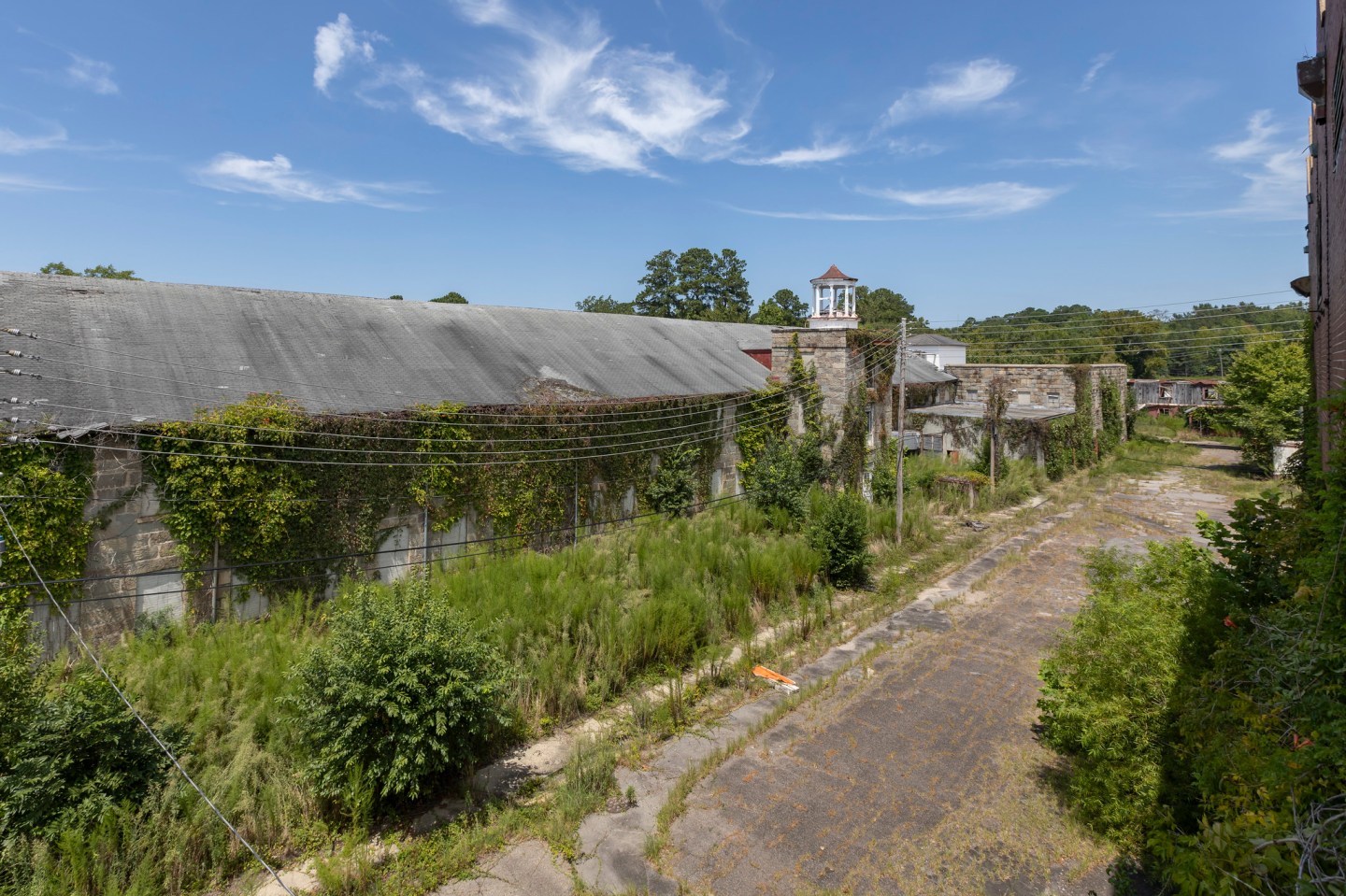
In 1845, William Gregg purchased 7,952 acres near Horse Creek in Aiken County, South Carolina and established the Graniteville Manufacturing Company. Gregg was a visionary industrialist who advocated for the production of textiles in southern mills earning him the title “Father of the Southern Textile Industry.” He is also known for implementing one of the first compulsory education systems in the United States. In 1846, Gregg began construction on both his factory and the surrounding town of Graniteville, soon developing the South’s first large-scale textile village.
Orphaned at the age of four, William Gregg went to live with his uncle, Jacob Gregg, in Alexandria, Virginia who was trained as a watchmaker. Jacob Gregg utilized his mechanical expertise to invent a device capable of carding and spinning cotton. The uncle and nephew moved to Georgia to establish a small textile plant, but the venture failed in the aftermath of the War of 1812. Following the war, Jacob Gregg encountered tough times and was unable to support his nephew. Impoverished by the collapse of his business, Jacob apprenticed William under his friend, Mr. Asa Blanchard. William Gregg spent a few years with Blanchard perfecting his watchmaking craft and trade. In 1821, William Gregg independently relocated to the industrial town of Petersburg, Virginia, to further refine his craft and perfect his skills.
After settling in Columbia several years later, Gregg used his knowledge from Asa Blanchard and his uncle to establish a successful mercantile business, trading materials such as jewelry, silver, and other hand-crafted specialty goods. In 1838, while continuing his watchmaker and silversmith business, Gregg acquired an interest in what became Gregg, Hayden & Co. He retired with a large amount of discretionary income. This acquisition made Gregg a partner in the jewelry business in Charleston, South Carolina. He moved his family to Aiken County following the acquisition. Gregg’s time spent with the jewelry and silver firm allowed him to secure his fortune and establish the financial security that would allow him to indulge in his original interest in textile manufacturing. Continuing his purchases in 1838; Gregg bought into the Vaucluse Manufacturing Company, a cotton mill in the Barnwell District of South Carolina, with his brother-in-law General James Jones.
In 1844, William Gregg traveled to the Northeast on a mission to study and examine numerous textile mills in Massachusetts, Connecticut, Vermont, and New Hampshire. He aimed to improve the struggling textile industry in the South, which was plagued by failures and undercapitalization. Upon his return to Charleston, Gregg actively engaged in the community. He wrote a series of articles for the local paper, the Charleston Courier, outlining ways for Southern businessmen to invest and prosper in manufacturing. Gregg criticized the South’s over-reliance on plantation agriculture and advocated for the development of a strong manufacturing sector to complement the agricultural industry. He published these articles in a pamphlet titled “Essays on Domestic Industry,” which strongly criticized planters for neglecting their ventures and allowing them to fail due to lack of attention and capital. Gregg envisioned Southern business capitalists leading industrialization by applying industry, prudence, and surplus capital to manufacturing plants and operations.

In 1843, William Gregg returned to Aiken County and purchased the Vaucluse Mill outright. The following year, he toured the large-scale textile villages of New England and became inspired to develop the same framework in South Carolina. He saw industry combined with education, worship, commercialism, and family life as the blueprint to success for Southerners. Gregg employed local laborers to begin construction of the Graniteville Canal in 1846. Quarried blue granite was used in the project that would eventually power Gregg’s cotton mill. However, the canal’s initial use was to power a sawmill that would supply the lumber needed for building the town.
With a group of Charleston elite an initial capitalization of $300,000 was granted. This money was put towards constructing a tremendous and massive state-of-the-art textile factory and plant on Horse creek, which was a couple of miles from Gregg’s Vaucluse Mill. The production and construction of the Graniteville Company relied on the local people of the area to build and operate the mill. Farmers, tenants, and the poor were employed with wages similar to those of Northern mill workers.

By 1849, the town of Graniteville, South Carolina was near completion and consisted of nearly 100 homes, several stores, two churches, and a school for mill children. All were paid for by William Gregg, who was highly regarded by everyone in Graniteville for putting his employees first. The mill village was ready for occupancy, and the mill itself was completed and operating that same year. The houses were designed for white workers, who made up most of the company’s employees. According to historical reports, the company’s few Black workers lived on the outskirts of the segregated town.
Gregg had realized his dream of creating a community dedicated to industry, production, and education. He insisted that his mill workers send their children to school at Graniteville Academy. Parents of school-aged children were not allowed to work in the mill unless their kids attended the academy. If children were late, 5 cents would be docked from their parent’s wages. William Gregg saw himself as the moral guide of his burgeoning community. He believed the South should rely less on its plantation economy and more on manufacturing.
During the 1850s, Gregg became famous throughout the South. His factory became acclaimed, and its model was celebrated. He was credited with providing the South a perfect example of the industrial development that reformers had demanded for many years. William Gregg became popular, leading to his election to the South Carolina House of Representatives in 1856. He also attempted to get elected to the state Senate but was unsuccessful. Gregg faced resistance regarding some of the practices at his plant, but this did not completely hinder his political career.
Despite William Gregg’s sudden death in 1867, just two years after the Civil War. The Graniteville Company continued to play a municipal and almost paternalistic role for many years thereafter. The Civil War left the South in ruins and Southerners became interested in Gregg’s ideas of industrialization. In the decades following the war, the Graniteville Company expanded, building new factories at neighboring Vaucluse and Warrenville and acquiring two mills (Sibley and Enterprise) in nearby Augusta, Georgia. However, declining profits forced the company into receivership briefly in 1915, but it emerged in just 17 months, thanks to government orders brought about by America’s entry into World War I.
The railroad runs parallel to the mill and just steps away from Railroad Avenue. It was the site of the first train tragedy in Graniteville on July 4, 1904. As reported by the New York Times on July 5, 1904, the wife of a local merchant was walking with her young daughter along the railroad tracks. Mom was on the street and her daughter had wandered over to the other side of the tracks, only a few feet away. Mrs. Engle heard and saw a train approaching and feared the approaching train would cause her small child to attempt to cross the tracks. As a mother’s instinct often does, she reacted in the only way she knew to save her child. Mrs. Engle stepped toward her child and into the path of the oncoming train. The child survived, but mom was hit by the train. Exactly 100 years, 6 months and 2 days later this tiny town would suffer yet another monumental loss of life at the hands of those busy railroad tracks at the heart of the community.
The 1920s and 1930s were lean years for Graniteville, with increasing competition and the Great Depression taking a toll on company profits. During the 1940s, war orders once again improved the company’s fortunes. This allowed the company to pay off all its debts and begin a large-scale modernization plan after the war. In the years following the war, Graniteville Company pioneered the production of permanent-press textiles. Graniteville Academy, now known as the Leavelle McCampbell Middle School, was sold to Aiken County in 1960 and currently operates as an Aiken County public school. The Graniteville Manufacturing Company, which once owned and maintained the community’s housing, sold all of the small homes to private owners by the 1960s. Acquired by Avondale Mills, Inc., in 1996, the remaining Graniteville facilities continued to produce high-quality denim, cotton, and specialty fabrics under the Avondale Mills name.
For more than a century, many trains traveled through the quiet mill town each day. A rail spur in the center of Graniteville serviced the Avondale plant, which employed most of the town’s citizens and received daily deliveries of chlorine gas via a Norfolk Southern train for mill operations. Freight cars carrying materials for the town’s textile plant were detached from the train and directed via rail switch to a rail spur, a length of track that often dead-ends and is used for offloading cargo. Before the 2005 train wreck, Graniteville was dotted with azaleas and sweet gum trees. Horse Creek was full of channel catfish and redear sunfish, bluegill and black crappies.
On January 6, 2005, at 2:39 A.M., Norfolk Southern freight train 192 traveling about 47 MPH approached the sleeping town. It carried paper, steel, and loads of kaolin, the white powdery mineral used to make fine China and soothe children’s stomachs. It also carried the hazardous materials sodium hydroxide, cresol, and liquid chlorine in pressurized 90-ton tankers. Train 192 was supposed to go straight through the center of Graniteville, past Johnny’s Custom Cabinet Store and the First Baptist Church, before heading toward Columbia. Instead, a switch left in the wrong position by another crew caused the train to fork off the main track and veer toward the plant.

The train operator frantically pulled the emergency brake, but it was too late. The freight train slammed into a parked locomotive, the metal twisting and sparking as 16 cars were thrown off the track. Diesel fuel pooled under the cars, kaolin powdered the bashed locomotives and tracks, and a 29-inch rip in the ninth car allowed liquid chlorine to gush out, mix with the air, and turn into a lethal gas. Plant workers who escaped, gasping their way through the poisonous fog, were joined at local hospitals by hundreds of residents whose lungs were burning. Within 90 minutes, more than 5,400 people would flee their homes.

A failure of a work crew to return the rail switch to the main line resulted in the Norfolk Southern freight train colliding with an unoccupied, parked train. The collision derailed both locomotives and 16 of the 42 freight cars of Train 192, as well as 1 of the 2 cars of the parked train. Among the derailed cars from Train 192 were three tank cars containing chlorine, one of which was breached, releasing chlorine gas. The train engineer and eight other people died as a result of chlorine gas inhalation. About 554 people complaining of respiratory difficulties were taken to local hospitals. Of these, 75 were admitted for treatment. Total damages exceeded $6.9 million.
The crash sound awakened local residents, and initial notification came through a 911 call within 1 minute. The Aiken 911 call record indicated reports of a “bleach gas smell and smoke on the ground,” and at least one caller identified chlorine. Fire and rescue services responded within 1 minute of notification and were en route within 1 more minute; however, upon hearing a radio report of a “smell of chemicals,” the fire department chief ordered responders to stand by. Within 6 minutes, the fire department chief stood 1,000 feet from the crash and was forced to withdraw lest he be overcome by chlorine fumes, which were spreading rapidly and approaching critically toxic levels. Within 13 minutes, the chief recognized the need for a mass evacuation and relocated upwind. Emergency responders marshaled personnel and equipment, established incident command, requested mutual aid, activated Reverse 911 with instructions to shelter in place, and initiated a major evacuation. However, these actions did not take place with immediacy and efficiency.
The chlorine gas had already affected many people: the train’s engineer (who had survived the crash), three workers in the mill, a truck driver sleeping in his cab, a man in a shack one block from the wreckage, two workers who had evacuated the mill on foot into the woods, and one other person. Poor communication between agencies and a lack of clear decision-making authority exacerbated the disaster. First responders disagreed over how to evacuate the town, and this disagreement resulted in inaction.
As callers reported people dying around them, 911 could do nothing but advise everyone to stay inside. In the most extreme example, one mill worker stayed on hold with a 911 operator for 28 minutes. The operator advised him to stay inside and wait for help while the caller labored to breathe and screamed in agony. After those 28 minutes, that call ended with a disconnection. The caller followed instructions and waited in the mill for 4 hours for help to arrive before he dragged himself out of the plant and drove himself to evacuate. Automated Reverse 911 called people and advised them to stay in their homes and turn off their air circulation, but this system did not start until 4 hours after the incident.
The devastating wreck, from which Graniteville still hasn’t completely recovered, didn’t have to happen. It was preventable using a technology that the National Transportation Safety Board urged for 35 years until Congress finally stepped in and mandated it. The NTSB asked railroads to employ a form of automated train control as early as 1970 after a head-on collision between two commuter trains in Connecticut killed 4 and injured 45. The Federal Railroad Administration considered it but decided that it was too expensive. Over the next four decades, the NTSB investigated accident after accident that investigators said could have been prevented with positive train control. Had railroads installed such a system, more than 780 accidents might have been prevented. Within 3 years of the crash in Graniteville, the NTSB had investigated 5 more train accidents that positive train control could have prevented, adding 206 injuries, 6 fatalities, and around $25 million in damage.
The 2005 Graniteville train wreck became one of the worst railroad-related chemical spills in United States history. A little more than a year later, in June 2006, Avondale Mills announced they were closing their doors after 161 years of operation, citing unfair global competition exacerbated by a disastrous train derailment. The closure affected 4,000 associates – many representing the second, third, fourth or even fifth generation of their families to have worked for the company – at its various facilities in Georgia, Alabama, and South Carolina. The mills closing left roughly 1,600 people in Graniteville without employment.
In recent years before the wreck, Avondale Mills had invested more than $300 million to upgrade facilities and equipment to bolster its competitive position in a difficult global environment. However, the train accident that took the lives of several Avondale associates and caused insurmountable damage to the plant ultimately derailed the company itself. The chlorine spilled in the accident had gotten into the plant’s machinery, damaging the electrical parts and causing unmanageable levels of rust. For the first time since 1849, the mill was silent. The town of Graniteville went dark and remained that way for nearly a decade.
Beginning in 2011, a couple of Atlanta entrepreneurs began buying up pieces of the sprawling mill complex from a local developer. They repainted the town’s landmark water tower, and in 2014 opened a home appliance de-manufacturing business in one of the former mill buildings. Then they rehabilitated Hickman Memorial Hall, a circa 1907 community center, using federal and state historic tax credits. These projects give Graniteville hope for a brighter future. In a public forum held in 2020, 15 years after the train derailment, advocates and public health experts outlined some of the effects of the disaster on the surrounding community, including decreased lung function and increased blood pressure in those who were exposed.


Thank you for reading this blog! Please share it with your friends. I appreciate your continued support. You can connect with me on Facebook, Instagram, and TikTok. Explore my collection of photography books to discover more incredible, abandoned sites throughout the Southeast.
Discover more from Abandoned Southeast
Subscribe to get the latest posts sent to your email.

Is it for sale, only interested in properties that are for sale. Thanks and have a great day.
Sincerely,
Stan Battersby Realty USA Southwest 602-486-1486 stanbattersby@gmail.com
LikeLike
Great history lesson! Thank you!
LikeLike
What a beautiful building it once was. Such a shame that it was lost. Such a tragic story of loss of life. Thank you for researching this property.
LikeLike
I remember this train wreck story and the death and destruction it caused, including the eventual closing of the major area employer. Not sure what the railroad settlement was for the local people and the company. So sad this preventable accident ruined such a nice Southern town.
LikeLike
Very cool that you caught some glimpses of yesteryear! Hardly ever a safe task. Bravo!! 👏🏼
LikeLike