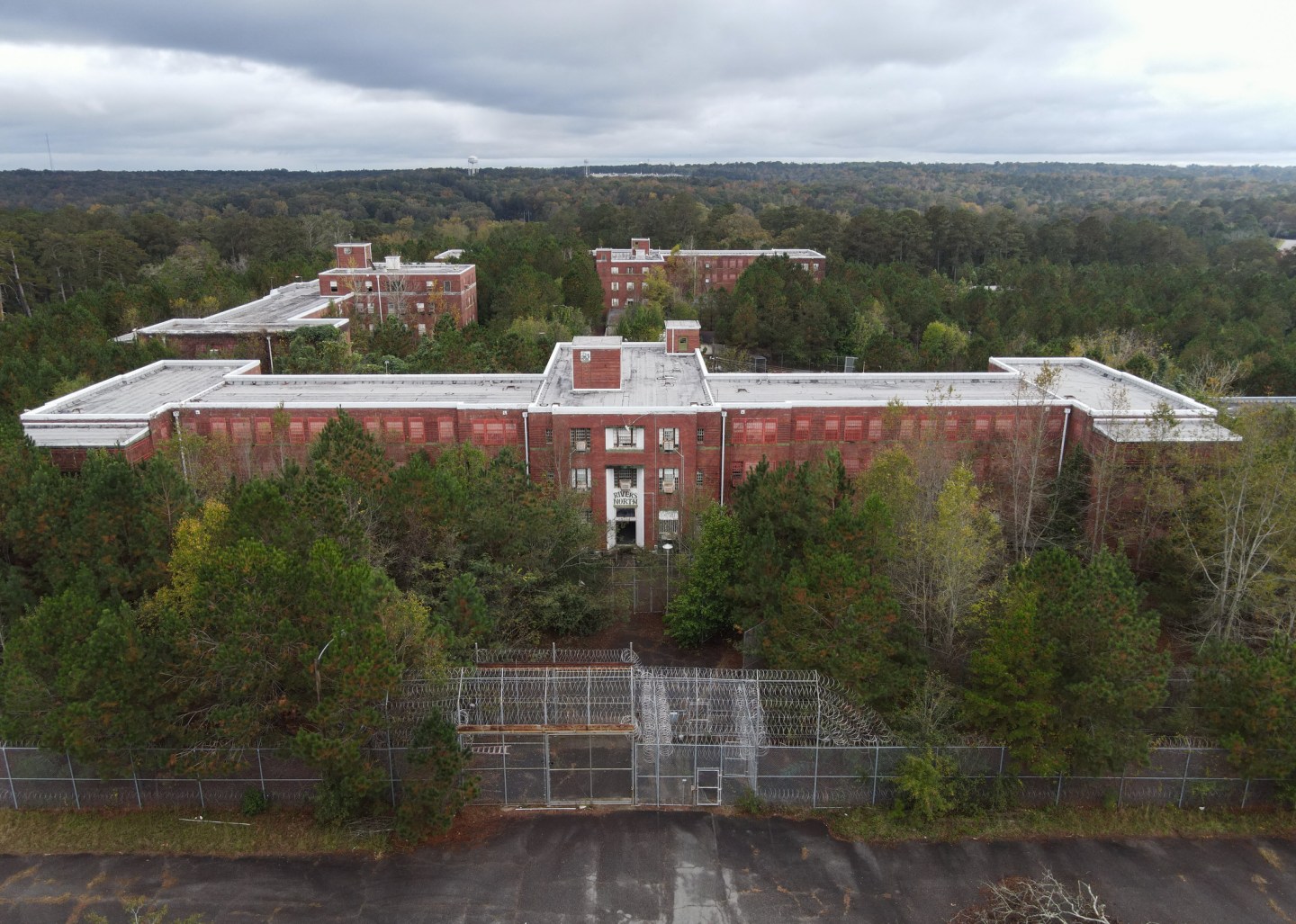
Rivers State Prison was originally built as part of the Central State Hospital complex in Milledgeville, Georgia. As of 1937, Central State’s population exceeded 7,200, surpassing the capacity of a facility designed for fewer than 5,000 patients. Some of the existing hospital buildings were nearly 100 years old and in very poor condition. The hospital had not seen any significant new buildings added in the past 20 years. In June 1938, Governor Eurith Dickinson Rivers made plans to use the newly enacted W.P.A. and the P.W.A. programs to secure funds for improvements. The condition of the buildings was so bad that Governor Rivers was quoted as saying his proposed building program was “a race with impending tragedy”. Governor Rivers requested $10 million in funding for the hospital building project. This included repairs and additions to existing buildings and construction of new buildings to alleviate extremely overcrowded conditions.

The site chosen for the new buildings was four miles southwest of the established hospital facility. In August 1938, $500,000 to fund repairs and additions was approved, and work began. In late October 1938, the P.W.A. refused the application for the new building funds. Soon afterwards, Gov. Rivers made a special trip to Washington, D.C. to seek the help of President Franklin D. Roosevelt. Their new plan required the creation of the State Hospital Authority and the issuing of $2.25 million in revenue bonds to be paid back by the income from paying patients. The Reconstruction Finance Corporation purchased the bonds with the agreement that the P.W.A. consent to make a grant for an additional $2 million. These funds, along with the initial P.W.A grant of $2 million, brought the total available funds to nearly $6 million.
Due to the reduction in building funds from the initial amount requested, Gov. Rivers instructed Robert and Company, Inc., Architects and Engineers, of Atlanta, to prepare new plans. A new site was selected adjacent to the existing hospital facility. Then another problem arose. To avoid losing the first $2 million grant, work had to begin on the project before the end of December 1938. The issuance of revenue bonds for financing the project was contingent upon the establishment of the State Hospital Authority by the Georgia General Assembly, which convened in early 1939. Gov. Rivers arranged for the State Department of Public Welfare to let contractors begin a small amount of grading work in December, thus fulfilling the first grant requirement.
The State Hospital Authority was created in February 1939 and acquired a 132-acre tract of land in March 1939 from hospital lands purchased in 1850 and 1854. The construction of three new H-shaped buildings, a T-shaped building and a tuberculosis hospital group also began in March 1939 and buildings were completed by the end of 1940. The tuberculosis hospital is a group of three large buildings connected by an underground tunnel system. When this building complex was completed, it was hailed as the most modern and best equipped tuberculosis hospital in the nation and accommodated more tuberculosis patients than the State Tuberculosis Hospital in Alto, Georgia. The buildings were named for Governor Rivers.

The construction of the tuberculosis hospital, the Rivers Buildings, forced the removal of nearly 2,000 bodies from the northern part of the New Colored Cemetery, one of the three cemeteries located at Central State Hospital. In 1938, trench graves were dug at the South Camp Creek Cemetery for the bodies moved from New Colored Cemetery. The metal grave markers were also moved and replaced on each grave. Two citizens of Milledgeville, Floyd Griffin, Sr. of Slaters Funeral Home and Mickey Couey of Moore’s Funeral Home, verified the moving of these graves. Mickey Couey declared that the relocation of the graves was not conducted by local funeral homes, but rather by the state government. No evidence has been discovered to determine if the hospital’s Engineer Department or a contractor hired by the Department of Public Welfare actually moved the graves. The event appeared to garner minimal public interest and may have been carried out informally, lacking established procedures. Grave marker numbers and burial records indicate that most of the bodies that were moved were African American males. The South Camp Creek Cemetery, now obscured and neglected, lies concealed within the woods of the hospital grounds.
The Rivers Buildings were later converted to a state prison and renamed Rivers State Prison. In March 1981, the state Department of Offender Rehabilitation asked the General Assembly for $3 million to renovate the vacant facilities at Central State to house a critical overflow of prisoners. More than 1,350 state prisoners were backed up in county jails because no state prison beds were available, and that number was expected to grow to more than 1,500 if the department did not act soon. The funding was approved to open the old Rivers Buildings in Milledgeville to house 600 inmates. Since the facility was built as a mental health dormitory, it lacked security design features of other purpose-built prisons and required more staff.
Upon arrival at Rivers State Prison, one of the first sights that greet new inmates is a sign at the rear gate proclaiming, “We work for a living.” This motto encapsulates the daily reality for the inmates at Rivers, as they engage in various work programs each day. There were little to no luxuries, not even cable TV. Inmates were required to stand at attention twice daily for inspection. Their shoes must be polished, and foot lockers must be kept military-ready at all times. They were woken up at 5:30 A.M. and not allowed to hit their bunks again until 4:30 P.M. Every inmate was assigned a detail, from dorm orderlies to picking up cigarette butts on the wellness walk yard. The prison also required two daily walks of four miles each, one in the morning and one in the afternoon, for anyone unable to walk while on work details.
Of course, there were always those looking for a way to escape. On August 14, 1995, 27-year-old Billy Ray Moon escaped from his work detail at Rivers by climbing over a fence at the prison industries warehouse. He was serving a four-year sentence for burglary, forgery, and theft of services in Hall County. His wife was suspected in aiding in the escape. Moon was caught 17 months later in White County, Georgia. He was arrested by sheriff deputies who were responding to a domestic disturbance call. Moon was using an alias, but a photograph and physical description confirmed his identity.
In September 1996, two teenagers housed at the Child & Adolescent Unit on the first floor of the Powell Building climbed out a window and stole a prison van from Rivers State Prison. The 13 and 15-year-old boys, detainees from the Wrightsville Youth Development Center, used a hairbrush to bend back a 6-inch metal border around the top of the screen covering their window. After loosening the screen, the teens climbed through a very small hole and slid to the ground on tied-together bed sheets. The pair shattered a window of a parked and secured Rivers State Prison van, managed to hotwire it, and fled. Nevertheless, their escape was fleeting. The van was found parked on Sinclair Marina Road and the juveniles were arrested about 5:00 A.M. at a convenience store.
In 2003, the Department of Corrections started examining all of its facilities to determine how the department’s resources could best be used. They hired a firm to look at all of the prisons to see which should be invested in and which should not. Five years later, it was announced that Rivers State Prison would close in October 2008. In preparation for the prison’s closure, more than 1,100 inmates were relocated in August 2008. The closure came at a time when the Department of Corrections added more than 300 new beds to the state prison system through new construction and the addition of triple-bunk beds. About 200 of Rivers’ male inmates were transferred to other nearby prisons in Baldwin County and the rest were absorbed by prisons across the state. The roughly 260 employees working at Rivers were offered jobs at other prisons within a 45-minute drive. When Rivers closed, there were no plans for the buildings.
For more than a decade, the prison grounds remained idle, as officials had no use for the buildings and no funds to demolish them. In 2019, a film production company leased the property from the Department of Corrections. Several low-budget movies were filmed at the prison, leaving behind fake blood, zombie dummies, and burned-out cars scattered throughout the buildings. Now left abandoned by the Department of Corrections, the former Rivers State Prison grounds have been left to mother nature and vandals.


Thank you for reading this blog! Please share it with your friends. I appreciate your continued support. You can connect with me on Facebook, Instagram, and TikTok. Explore my collection of photography books to discover more incredible, abandoned sites throughout the Southeast.
Discover more from Abandoned Southeast
Subscribe to get the latest posts sent to your email.

Perhaps these buildings could still be used as filming locations for various movie projects. But only the safe potions that is. At least that’s one way the state could gain some funds for other much needed projects.
LikeLike