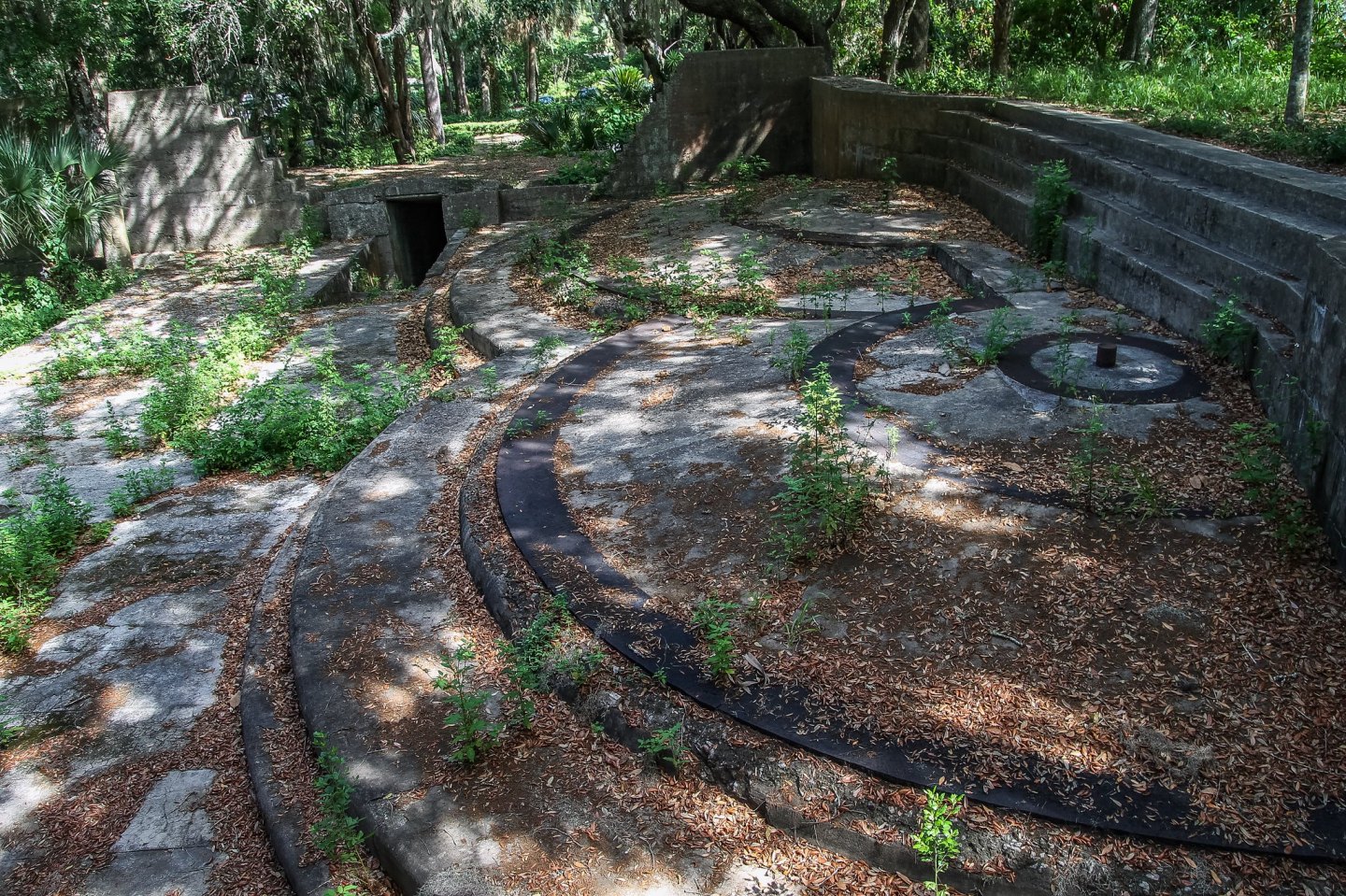
In 1898, national attention focused on Florida as the Spanish-American War began. In March 1898, the federal government sent U.S. Army General Wilson to Jacksonville, Florida to survey the St. Johns River. It was decided that emplacements for two eight-inch breech-loading rifles would be built along the river atop St. Johns Bluff as a coastal defense against a possible naval attack from Spanish Admiral Pascual Cervera’s fleet. Construction began on the Spanish American Battery in April 1898. On April 15, the American flag was hoisted there, to speak defiance to the Spanish, who from this same elevation made the charge upon the French Fort Caroline 333 years before. With the raising of the flag, St. Johns Bluff had now witnessed the flags of five nations, flying over nearby fortifications.
The “tram” was laid up the slope, and through the jungle, and was powered by an engine at the summit. The fort was built entirely of granite concrete on a thick foundation of shell concrete, or “tabby”. The roofs of the bombproof magazine were constructed with steel I beams and channels. The original metal doors have long disappeared, and the “tram” tracks have been removed. The Battery was completed in May 1898; however, Admiral Cervera’s fleet was destroyed in Cuba. The Battery was dismantled in October 1899 and its guns were sent to Pensacola. By the 1920s, the bomb-proof concrete structure with a sweeping view of the river was sold as a government surplus.

The fort is one of four that was erected along the river at various times. The French Huguenots, the Spanish Empire, and the Confederacy all had forts that came and went. The Spanish American War Battery was documented by the National Park Service in 1934 as part of the Historic American Buildings Survey. At that time, it was listed as perfectly preserved. In the following decades, the fort was largely forgotten and overgrown.

The fort was eventually surrounded by suburban houses. The property was purchased at a tax deed sale in 2013, and the buyer, a local developer, had considered demolition to build a house for retirement. In 2016, the North Florida Land Trust announced it acquired a Jacksonville Spanish-American war fort that was almost lost forever. A combination of $162,000 in city funds, a $100,000 donation from the Delores Barr Weaver fund, and other support combined to meet the $400,000 purchase price.
Two years later, in December 2018, the North Florida Land Trust donated the property to the National Park Service. More than a century after the last soldier left, the once-forgotten fort was back in the hands of the federal government that once sold it. The fort will be added to the Fort Caroline memorial and will become part of the National Park Service’s educational programming. The Park Service wants visitors to see the fort’s connections to Jacksonville, but it will take a while to figure out the best way to present that. The NPS is working on how to handle public access and what to tell visitors about the place. For now, the property remains closed to the public.


Thank you for reading. Please share the blog with your friends. I appreciate your support. You can find me on Facebook, Instagram, and TikTok. For more amazing, abandoned places check out my photography books.
Discover more from Abandoned Southeast
Subscribe to get the latest posts sent to your email.

1 comment