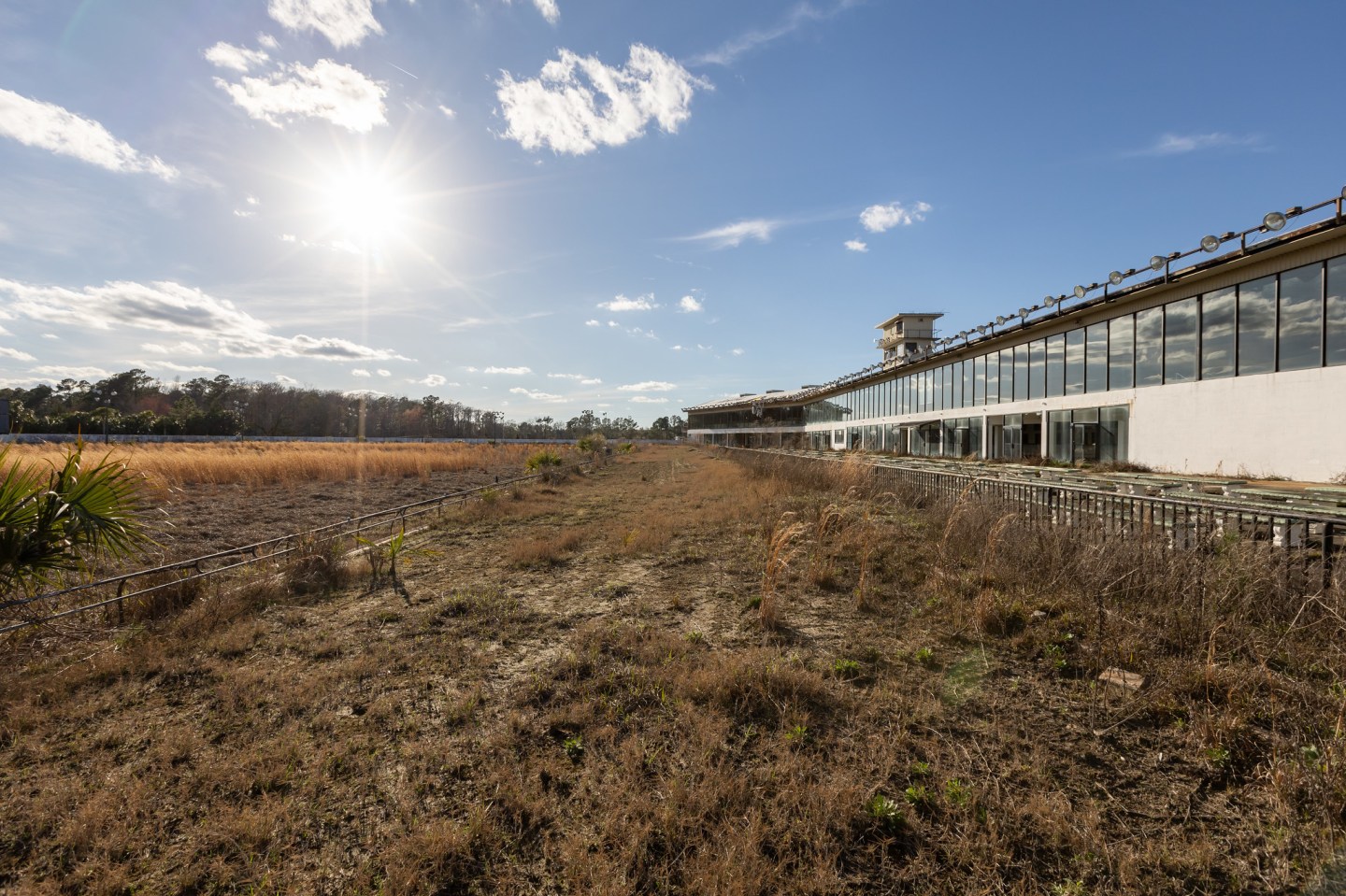
Florida’s first greyhound racetrack opened in Hialeah in 1922, nine years before betting on dogs was even legal. Some tracks skirted that restriction by offering the purchase of “options” of winning dogs. But in 1931, hoping to add money to the state’s coffers during the Great Depression, legislators overrode a governor’s veto to approve gambling on races. Florida became the first state to allow greyhound racetracks to operate legally in 1931. By 1935, the Sunshine State had ten greyhound tracks — several of them in South Florida — and they’d become a top tourist destination. Greyhound racing was as synonymous with trips to Florida as theme parks are today.
Stevens Anthony “Steve” Andris was born and raised in Savannah, Georgia. In addition to founding the Greek Orthodox Church in Tallahassee, he was also instrumental in founding the Greek Food Festival there. Following his service in the United States Air Force he moved to the Tallahassee/Monticello area where he started the Jefferson County Kennel Club (JCKC) in 1958. In addition to never having attended a race, Andris was not familiar with racing dogs themselves. Nevertheless, Andris dreamed of owning a greyhound track one day. After convincing Jefferson County to permit him to build and operate the track, Andris and his team won the ballet in 1958.
His father loaned him $25,000 so he could build a greyhound track in Monticello. After a year, Steve Andris did not have the money he envisioned making once the track opened. He sold stock in the racetrack, selling pieces of his business for anywhere between $1 and $3. Soon 500 stockholders were helping support the track. Andris was careful to maintain the majority of ownership, so when people were ready to cash out, he was the buyer. In 1994, he bought all the stock back, reclaiming complete ownership of his racetrack.


Steve Andris always arrived at the Jefferson County Kennel Club at 9:00 A.M. and would leave at noon – only to return and oversee the results of each race. There was never a time he was seen without a suit. It was also reported that Steve Andris was as generous with his money as he was prosperous, and he ended up giving a lot to the community and supporting local organizations and causes.

At its height in the 1980s, greyhound racing was rated the 6th most popular sporting event in the United States. The Jefferson County Kennel Club did more than fulfill a dream for Steve Andris, it also served as an employer for many local residents. JCKC generated nearly 300 jobs annually and contributed significantly to the local economy in Jefferson County during its heyday. Andris also knew he needed to add more attractions to keep his enterprise profitable. With that in mind, he added a poker room in 2003, where Texas Hold’Em was played. The cards eventually became more profitable than greyhounds. By the early 2000s, Andris only had 70 employees, and his clientele continued to diminish.
Between 1990 and 2013, gambling at dog tracks in Florida declined by 72%. Steve Andris’ lofty empire was crumbling around him. Greyhound racing is also notoriously bad in Florida, and Jefferson County Kennel Club was no exception. Dog kennel owners were not required to report greyhound deaths under any mandatory laws. Investigators found evidence of dog abuse at the Jefferson County Kennel Club in 2003. Kennel owner, Saul Mays, was investigated at his Monticello kennel, and again in 2005. In 2010, a third investigation discovered seven “very thin” dogs and others covered in tick bites.
When Saul Mays applied for a license to own and train greyhounds in 2002, his rap sheet signaled he was not a model citizen. Convicted of kidnapping his estranged wife at gunpoint in 1988; after taking her into the woods and sexually assaulting her, he had served three years in prison. The staff at the Florida Division of Pari-Mutuel Wagering recommended Mays’ application to race dogs be denied, but Mays appealed and was granted a license. In each case, state regulators concluded there was not enough evidence of abuse, and no action was taken.
After the Jefferson County Kennel Club closed in 2011, many of the greyhounds were given up for adoption, but not all. According to a study commissioned by the Florida legislature, the state lost between $1 million and $3.3 million on greyhound racing in 2012. In 2013, the reporting of dog deaths became mandatory, and between May 31, 2013, and December 31, 2016, a racing greyhound died every three days on average in Florida.
In November 2012, the Board of Directors of the National Greyhound Association (NGA) took special action banning kennel operator Saul J. Mays from any further involvement with NGA-registered greyhounds. The Board also took action prohibiting any NGA member from conducting greyhound business with Mays. The lifetime ban is the most serious penalty available under NGA rules. NGA Executive Director Gary Guccione said Mays was banned for conduct deemed discreditable, including improper care of a number of greyhounds turned over to adoption organizations at the end of their racing careers. Adoption organizations and racing community members provided statements used as evidence in the disciplinary hearing.
State voters overwhelmingly approved Amendment13 in 2018, outlawing greyhound racing after December 31, 2020, and issuing what could become a national death sentence for a century-old sport. To achieve this result, animal organizations like the Humane Society of the United States, the National Greyhound Association, and GREY2K USA spent many years lobbying in Tallahassee to remove the coupling requirement, which allows the racetracks to continue sponsoring other forms of gambling, like card rooms, without the mandate for live dog racing.
Many people did not realize how bad things were at Jefferson County Kennel Club. David Wolf, director of the National Greyhound Adoption Program, knew Steve Andris for more than 20 years. He stated that just down the road from the track is a veterinary clinic with a 5-acre field and a backhoe. The veterinarian, one of two in the area, was known to do mass euthanasia of former racing greyhounds. He would then dig trenches and dump the bodies in. When the field was completely filled with neat rows going one direction, he would start digging new trenches perpendicular to those rows. As he would dig, the bones of the previously buried dogs would resurface.

According to Wolf, Jefferson County Kennel Club had always been a slaughterhouse for greyhounds. Many of the dogs saved were only a tip of the iceberg and a kill truck regularly visited the racetrack. Wolf stated, “When I would visit the track back in the day, I had a pari-mutuel license to pass through the gate. Approaching the kennel compound, even from a distance, the odor was so strong it could knock you down. The kennels then were old and crummy. The turnout areas were so small that a kennel staff person would have to be picking up poop as the dogs went or else another dog would step in it. The carpets in the cages for the dogs to lay on reeked. It was a dismal place.”
Wolf continued, “I can say the same thing for the track owner whom I met with way back then. He was a dismal person. While I was there, I can actually say that I feared for my safety. It was clear that he would not help the dogs. He cared little for them and usually kennel operators owed him money for food. He was always one-up. I suspect, as with the rest of the tracks in Florida, his clientele base has continued to diminish and relies heavily on high stakes card playing. JCKC should have been closed long ago. It has always been a terrible place and it will be until the day it disappears. I am sure that if the Pari-mutuel Division made daily inspections, they would find a way to close it down. But I am also sure the Pari-mutuel Division doesn’t care to do that. In my view, they have never cared. So here we are in Florida with a a track owner that never cared, who runs an operation that is dismal, with a Pari-mutuel Division that doesn’t care, in a state that doesn’t care. And THAT is what I know about JCKC.“
According to his obituary, Steve Andris died on February 5, 2020, at his home in Monticello, at the age of 90 and is survived by his wife of 50 years, Jackie Andris. When Amendment 13 passed in 2018, 11 of the country’s 17 remaining active greyhound racetracks were in Florida. As of 2025, there are only 2 remaining active greyhound racetracks in the United States, both located in West Virginia. The 138-acre site of the former Jefferson County Kennel Club is currently for sale for $3.5 million.


Thank you for reading this blog! Please share it with your friends. I appreciate your continued support. You can connect with me on Facebook, Instagram, and TikTok. Explore my collection of photography books to discover more incredible, abandoned sites throughout the Southeast.
Discover more from Abandoned Southeast
Subscribe to get the latest posts sent to your email.

1 comment